



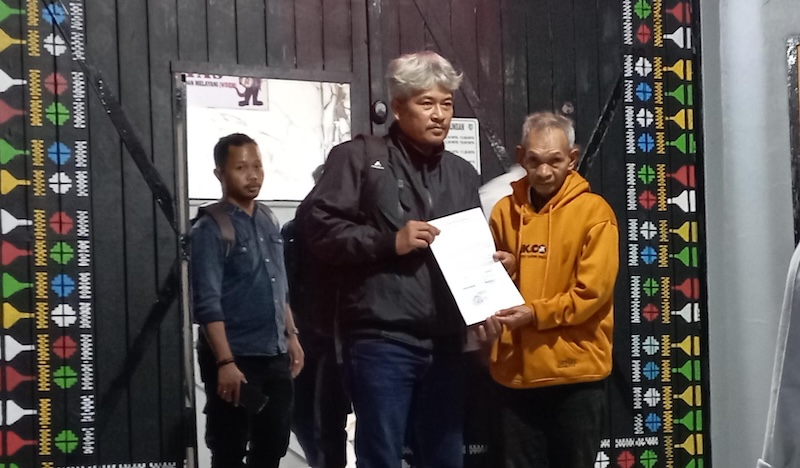
Floresa.co – A court in Flores island, East Nusa Tenggara province has acquitted a farmer who was accused of illegally logging inside a protected forest, in a ruling that has reignited calls for the government to clarify contested boundaries between conservation areas and Indigenous land.
The Ruteng District Court in Manggarai Regency declared Yohanes Flori, 57, not guilty of charges related to logging inside the Ruteng Tourism Park (TWA Ruteng), a conservation area spanning parts of Manggarai and East Manggarai regencies on Flores island.
During the hearing on April 10, presiding judge I Made Hendra Satya Dharma said prosecutors had failed to prove the allegations “lawfully and convincingly”, ordering Flori’s immediate release and the restoration of his civil rights.
Prosecutors had charged Flori under Indonesia’s 2013 law on forest destruction, accusing him of cutting trees inside a forest zone without a central government permit and of carrying out illegal logging. The court ruled both charges unsubstantiated.
The judges also ordered the return of confiscated timber, including several wooden beams and planks seized during his arrest.
Flori was detained by officers from the Natural Resources Conservation Agency (BKSDA) in March 2025 while building a house in Lok Pahar village.
He was later held at a detention centre in Ruteng from December 2025, with his trial beginning in January.
Indigenous land claims
Flori’s lawyers said he had been working land recognised under Indigenous customary law, despite its overlapping status with the state-designated conservation area.
“He lawfully cultivated the land through customary procedures after obtaining permission from local traditional leaders,” lawyer Maximilianus Herson Loi told Floresa.
“This ruling sends a clear message that Indigenous people should not be criminalised for non-commercial activities carried out on their ancestral land,” said Herson, who also heads the local chapter of the Indigenous Peoples Alliance of the Archipelago (AMAN).
Rights advocates say the case highlights a longstanding problem across Indonesia, where millions of hectares of Indigenous land overlap with state-owned forests, leaving local communities vulnerable to prosecution.
The Ruteng Nature Recreation Park covers more than 32,000 hectares, much of which Indigenous groups say falls within their customary territories.
Calls for boundary review
Lawyers and Indigenous leaders called on the government to urgently revise forest boundary maps to prevent similar cases.
“The claim by conservation authorities over customary land must be reviewed,” Herson said.
“Without a clear and fair boundary settlement, these conflicts will continue,” he added.
Another defence lawyer, Jimmy Z. Ginting, said the ruling should serve as guidance for law enforcement agencies dealing with communities living near forest areas.
“This is substantive justice for small farmers and Indigenous communities,” he said.
Indigenous leaders welcomed the verdict, urging regional authorities in East Manggarai to formally recognise and protect customary land rights.
Indonesia is home to hundreds of Indigenous groups whose land claims often predate modern state boundaries.
While a landmark Constitutional Court ruling in 2013 recognised customary forests as distinct from state forests, implementation has been uneven, and disputes with conservation agencies remain widespread.