



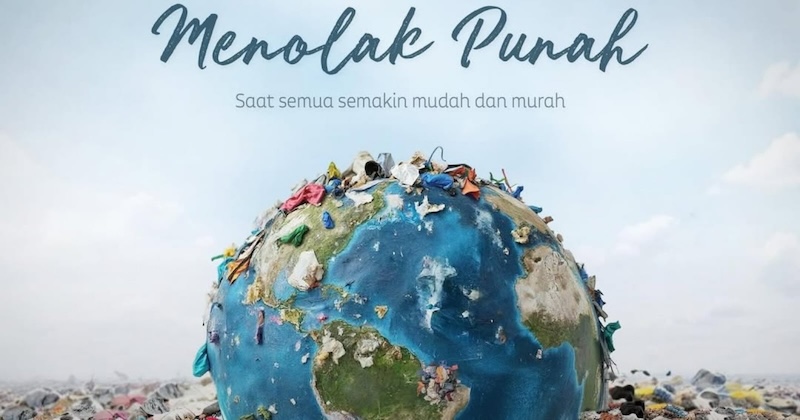
Floresa.co – The documentary does not open with catastrophe.
There are no floods, no burning forests, no images of industrial waste pouring into rivers.
Instead, the camera lingers on something almost everyone recognises: a person browsing racks of cheap clothing, choosing quickly, paying a little, moving on.
It is a scene repeated billions of times a year across the world. And according to an Indonesian documentary Menolak Punah or Resisting Extinction, it is quietly making us sick.
The film, directed by veteran journalist and filmmaker Dandhy Laksono together with Aji Yahuti Ramyakim, premiered in Jakarta in early April.
Its subject is microplastics: the microscopic fibres shed by synthetic clothing every time a garment is washed, fibres that flow from household drains into rivers and oceans, and eventually return to the human body through water, food, and air.
What makes Menolak Punah unusual in the crowded field of environmental documentary is its insistence on placing this global crisis inside the body rather than outside it.
It is not in a melting glacier or a polluted shoreline, but in the bloodstream of a pregnant woman, in amniotic fluid, in the lungs of a child.
Inside the Body
The science the film draws on is relatively recent, and still emerging — but already alarming.
Research by Ecological Observation and Wetlands Conservation (ECOTON), a leading Indonesian environmental group, conducted in collaboration with the Faculty of Medicine at Airlangga University in Surabaya, East Java has detected microplastic particles in human blood, amniotic fluid, the urine of pregnant women, and seminal fluid.
The findings mirror a growing body of international research. Studies published in recent years have found microplastics in human placentas, in lung tissue, and in the brains of deceased individuals.
The health implications remain an active area of scientific inquiry, but researchers have identified potential links to oxidative stress, inflammation, and long-term organ damage.
Polyester — the synthetic material that now dominates global textile production — is a particular concern. A direct derivative of plastic, polyester clothing releases hundreds of thousands of microfibres per wash cycle.
These fibres are too small to be filtered by most wastewater treatment facilities and have been found in ecosystems from the Arctic to the deep ocean floor.
“What we call cheap today,” Dandhy said at the film’s Jakarta premiere, “could become very expensive healthcare costs in the future.”
A Global Industry, A Local Wound
Indonesia is not a peripheral player in the story of fast fashion.
It is one of the world’s major garment-producing nations, supplying clothing to some of the largest international retail brands.
The industry employs millions, many of them women.
But Menolak Punah points to a contradiction that runs through the country’s relationship with textiles — one that extends far beyond factory floors.
Indonesia’s national emblem features rice stalks and cotton bolls, symbols of agricultural self-sufficiency. Yet the country imports 99 percent of its cotton.
Its domestic textile industry, including communities with centuries-old weaving traditions, has grown increasingly dependent on polyester yarn — cheaper, faster to produce, and easier to source than natural fibre.
The consequence, the film argues, is not only environmental. It is cultural and bodily.
Where Tradition Meets Toxicity
Nowhere is this tension felt more acutely than in the weaving communities of eastern Indonesia — a region known for some of the most intricate handwoven textiles in the world.
On the island of Flores, East Nusa Tenggara province, traditional cloth known as tenun has been produced for generations using natural cotton thread and dyes derived from plants, bark, and roots.
Each pattern carries meaning — recording kinship, ritual, and the weaver’s relationship with the land.
Elisabeth Hendrika Dinan, who goes by Ney, directs Sunspirit for Justice and Peace, a civil society an economic empowerment organisation based in Labuan Bajo, a small town on Flores’ western coast.
Through its Rumah Tenun Baku Peduli or House of Mutual Care Weaving, the organization supports local weavers in preserving natural materials and techniques.
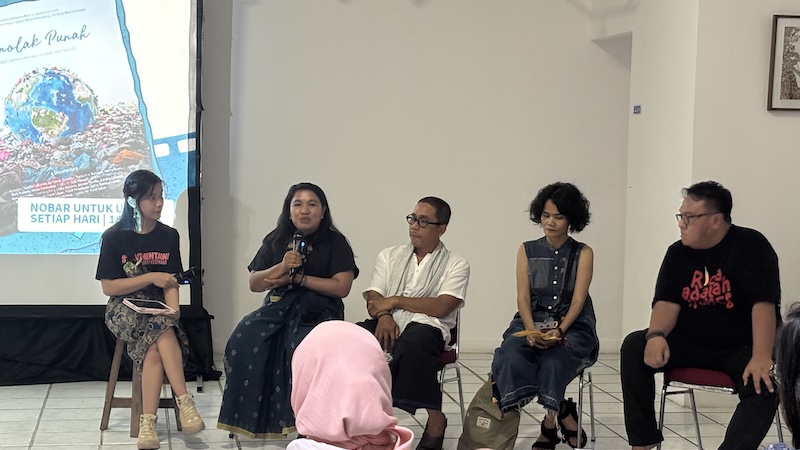
Ney appears in Menolak Punah and has become one of its most articulate voices on the intersection of environmental and cultural harm.
“In Flores, many weavers now use polyester yarn and it has become normalised,” she said.
“Yet polyester has a direct impact on plastic waste and microplastic pollution.”
She is careful not to assign blame to weavers themselves.
Polyester, she explains, was introduced through subsidy programmes and distribution networks that made it the cheapest and most accessible option — a structural choice, not a personal failing.
The harm, she argues, is layered. Traditional weaving is not simply a craft.
It is a form of ecological knowledge, a record of how communities understood and related to their natural surroundings.
When the yarn becomes synthetic, something more than fibre is lost.
“We often say weaving has a deep relationship with nature,” she said.
“But when the material is synthetic, that relationship is severed. There is a distance between culture and nature.”
In one of the film’s most memorable scenes, Ney holds a flame to two samples of cloth.
Natural cotton burns cleanly and dissolves to ash. Polyester melts, bubbles, and leaves a hardened plastic residue.
One returns to the earth. The other does not.
The Dignity of the Weavers
Herlina Lenos, a weaver from Rumah Tenun Baku Peduli, frames the issue in terms of labour and recognition.
Women in Flores’ weaving communities spend months producing a single piece of cloth — learning techniques passed down through generations, sourcing natural dyes from the forest, spinning and dyeing thread by hand before the actual weaving begins.
When synthetic materials allow the same visual effect to be produced in a fraction of the time, the perceived value of the traditional craft collapses — and with it, the economic standing of the women who practise it.
“Inside weaving there is knowledge, a relationship with nature, and the long labour of women that is often not fairly valued,” Herlina said.
“When weaving is treated only as a cheap commodity made from synthetic materials, what is lost is not just the quality of the cloth — it is the dignity of the weaver.”
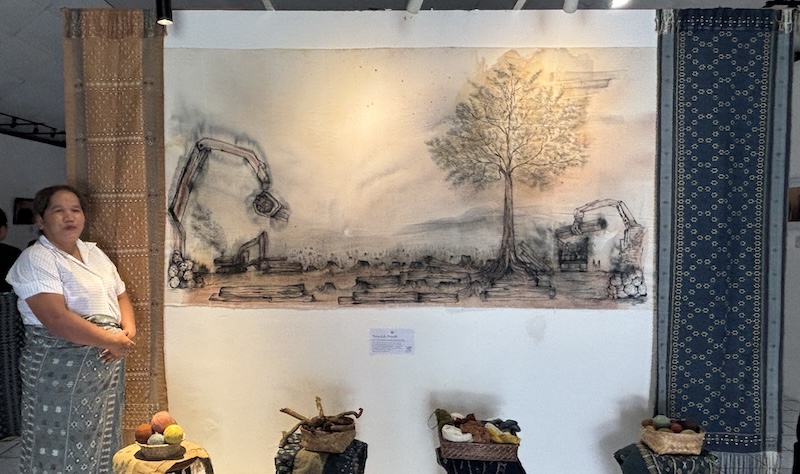
Communities Refuse to Disappear
The film’s title is a phrase used by several of the communities it documents: people who have made a deliberate, often economically difficult choice to maintain practices that the dominant market logic renders obsolete.
Among them: Yayasan Sekar Kawung in Tuban, East Java which works on organic cotton cultivation; Bidadari Lombok, which develops natural cotton and dyeing practices; and Komunitas Bersibersi Lemari, which since 2020 has collected secondhand clothing, redirecting wearable garments to those in need and repurposing the rest — with the involvement of people with disabilities — into products with economic value.
Also featured is Sejauh Mata Memandang, a fashion label that has built its identity around textile waste and sustainable production — an unusual proposition in an industry defined by speed and volume.
These are not large-scale solutions. Menolak Punah does not pretend otherwise.
What the film offers instead is something rarer: evidence that alternatives exist, are being practised, and are worth attention.
Co-director Aji Yahuti Ramyakim describes the film’s intention in modest terms.
“The film deliberately presents a complex problem, then finds its relevance in everyday life,” she said.
“The goal is for it to remain relevant to all audiences.”
It does not issue prescriptions. It does not end with a list of actions.
“It does not tell viewers to change immediately,” Aji said, “but it leaves behind a discomfort that is hard to shake — about what we wear, what we wash, what we throw away, and what we unknowingly pass on.”
That discomfort, the filmmakers suggest, may be where change begins.
On the Road
Following its Jakarta run, Menolak Punah has begun travelling to communities across Indonesia.
In Flores, the local premiere was held on April 18 at Rumah Tenun Baku Peduli in Labuan Bajo, attended by civil society representatives and local government officials.
Further screenings are planned across the island — in villages with living weaving traditions, in schools, and in community spaces — extending the film’s reach beyond urban audiences and into the communities whose lives it most directly concerns.
Menolak Punah was produced by Koperasi Ekspedisi Indonesia Baru, in collaboration with Sunspirit for Justice and Peace, The Body Shop Indonesia, and Sejauh Mata Memandang.