



Floresa.co – In a country that claims to uphold democracy, silencing the press no longer requires newsroom raids or overt repression.
A single request to a digital platform, one restriction click, is now enough to sever public access to information.
This quiet pattern of censorship has grown increasingly evident since the administration of President Prabowo Subianto took office, marked by tighter regulation of digital spaces and a stronger role of the state in determining what information is deemed “appropriate.”
In this new landscape, civil liberties—including press freedom—are no longer tested through open violence, but through administrative procedures that appear lawful on the surface while carrying significant coercive power.
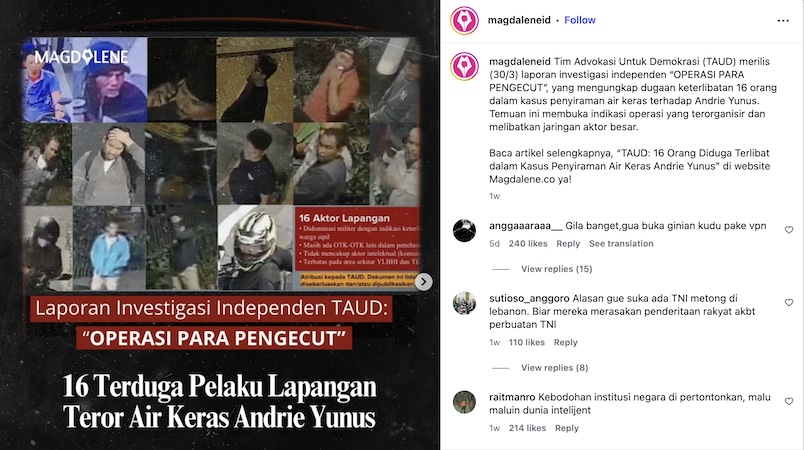
That was the case earlier this month when an Instagram post by the Jakarta-based online media outlet Magdalene suddenly became inaccessible to the public, following a request from Indonesia’s Ministry of Communication and Digital Affairs, known ase Komdigi, to the social media platform.
The incident immediately raised alarm among press organizations and advocacy groups, including the Press Council, which viewed Komdigi’s action not merely as a procedural flaw, but as a reflection of a broader state tendency to control the flow of information.
They warned that the move threatens press freedom and revives arbitrary practices that Indonesia sought to abandon after the fall of authoritarian Soeharto in 1998—a democratic regression now reappearing in a subtler, more technocratic, and less visible form.
“This restriction constitutes a serious act of silencing press freedom,” said the Journalist Safety Coalition (KKJ).
For KKJ—a coalition of 11 press and advocacy organizations—the issue extends beyond a single media outlet or one social media post.
At stake is a core principle of press freedom: the right of media to seek, process, and disseminate information through all available channels, including digital platforms.
The restricted Magdalene post reported allegations that dozens of military personnel were involved in an acid attack on Andrie Yunus, Deputy Coordinator of the Commission for the Disappeared and Victims of Violence (KontraS).
The content summarized an investigative report by the Advocacy Team for Democracy (TAUD), which has accompanied the case since the attack on March 12. According to TAUD, in addition to four military personnel already detained, the attack allegedly involved more than a dozen individuals.
The findings, published by Magdalene on March 31, sparked public discussion—until access was abruptly restricted.
Magdalene said it first learned of the restriction from readers on April 3, followed shortly by a notification stating that the action was taken at the request of Komdigi. The notice, however, did not cite any legal basis, specific articles of law, or clear justification—reinforcing concerns about unilateral action without accountability.
Public access to the post was restored on April 9 after widespread criticism and condemnation.
Although the content is now accessible again, Magdalene stated that “efforts to present independent and responsible journalism will always face challenges.”
“We hope similar incidents do not recur,” the outlet wrote on Instagram.
A Censorship Path Outside Press Mechanisms
KKJ stressed that any objections to journalistic work are clearly regulated under Indonesia’s Press Law, which provides mechanisms such as the right of reply, corrections, or complaints filed with the Press Council—not unilateral access restrictions enforced through state authority over digital platforms.
“All forms of censorship, banning, or broadcast suppression constitute legal violations as stipulated in Article 4(2) of the Press Law,” the coalition said.
According to KKJ, neither Komdigi nor any other authority has the right to judge or penalize journalistic work outside legally defined mechanisms. When the state bypasses those mechanisms, it is not law enforcement but an expansion of executive power over the press.
The censored content, KKJ added, clearly served the public interest. Reporting on alleged involvement of state agents in an attack against a human rights activist lies at the heart of the press’s watchdog role.
“Magdalene was fulfilling the press function to uphold the public’s right to information, safeguard democratic values, promote the rule of law, and defend human rights,” KKJ wrote.
As such, Komdigi’s action was deemed not only procedurally flawed but also a direct violation of the public’s right to know.
Rather than restricting access, the government, KKJ argued, should support the dissemination of information essential to transparency and accountability in law enforcement.
KKJ urged Komdigi to cease such practices and repeal regulations that enable censorship or hinder news publication in digital spaces.
The coalition also called on Meta, Instagram’s parent company, not to automatically comply with state censorship requests without considering press freedom and public interest principles.
“Platforms must ensure fair review mechanisms that respect journalistic content as protected expression,” KKJ said.
Komdigi’s Controversial Response
Responding to criticism, Alexander Sabar, Director General for Digital Space Supervision at Komdigi, said the action followed public complaints and a verification process.
“This measure was taken in response to public reports regarding content deemed potentially disinformative and provocative,” he said at a press conference on April 7.
Alexander claimed the analysis indicated the content could create misleading public perceptions, including unsubstantiated allegations and a potential decline in trust toward state institutions.
He added that Magdalene’s Instagram account was not verified as a media account nor registered with the Press Council, prompting content-based handling rather than institutional consideration.
“We continue to respect press freedom, but we also have a responsibility to maintain a healthy, accurate, and non-misleading digital space,” he said.
However, his statement triggered sharp criticism, as Indonesia’s Press Law does not require Press Council verification for a media outlet to operate.
Verification under Press Council regulations—stipulated in Regulations No. 3 of 2019 and No. 1 of 2023—is voluntary, not mandatory.
Abdul Manan, Chair of the Press Council’s Legal Commission, said Komdigi’s policy foundation needs review. The primary reference for determining press status, he emphasized, is the Press Law, not administrative verification.
Out of roughly 40,000 media outlets in Indonesia, only around 1,062 have factual verification and 179 administrative verification, highlighting verification capacity limits.
“If verification becomes the sole benchmark, does that mean the Press Council protects only about 1,200 media outlets?” Manan asked after a meeting with Magdalene and the Indonesian Online Media Association (AMSI) on April 8.
AMSI Chair Wahyu Dhyatkama reiterated that Magdalene is a legally registered Indonesian entity and therefore qualifies as a press company under the Press Law.
“Komdigi’s direct request to restrict public access clearly violates dispute resolution procedures outlined in the Press Law,” he said.
Rubber Regulations and Dangerous Digital Bans
Further criticism came from the Independent Journalists Alliance (AJI).
AJI Chair Nany Afrida said the Magdalene case reflects the impact of Ministerial Decree No. 127 of 2026 on Disinformation and/or Hate Speech, enacted last month.
She warned that vague phrases such as “disturbing public order” or “causing public unrest” are prone to abuse.
“Without independent and transparent oversight, this regulation risks becoming a censorship tool against information that conflicts with authorities’ interests,” she said.
Media scholar Wisnu Prasetya Utomo of Gadjah Mada University warned that digital bans are especially dangerous because they leave no physical trace but generate fear that leads to self-censorship.
Citing the 2025 Journalist Safety Index, he noted growing self-censorship among journalists, particularly regarding criticism of government programs.
“Because it’s invisible, normalization becomes a major risk. Society may lose access to information without realizing it,” he said.
Alternative media—often unverified but consistently serving marginalized communities—are considered the most vulnerable.
“When local media lose space, what disappears is not just press freedom, but access to information for already marginalized communities,” Wisnu warned.