


Indonesia is racing to shift from fossil fuels to renewable energy, presenting the transition as an urgent national mission.
Geothermal power sits at the center of that push, promoted as a clean and climate‑friendly solution to help the country reach its net‑zero emissions target by 2060.
To make this happen, the government has reshaped laws and policies to favour geothermal investment. A 2014 law removed geothermal from the mining category. Planning powers were recentralised. Project areas were declared national strategic assets. The Job Creation Law further eased investment rules.
The message is clear: geothermal development is meant to move forward, and resistance is not expected.
On the ground, however, communities tell a different story. In areas targeted for drilling, public spaces are filled with debate.
Supporters and opponents clash, exchanging data, testimonies and lived experience.
But beyond visible disputes lies a quieter battle — one that is easier to miss and harder to confront: the struggle over words.
Those who control language shape public debate. And those who shape debate influence how people think.
In this way, terms and labels become tools of power, used not to explain reality but to manage how it is understood.
This essay calls it a “terminology surge” — the deliberate flooding of public discussion with reassuring language. Like the projects themselves, it works best when it feels technical, harmless and inevitable.
Selling Energy Through Words
In the geothermal debate, a narrow set of phrases dominates: clean energy, green energy, low‑carbon, renewable, sustainable. These are repeated across policy documents, public meetings and media campaigns.
They are not random. Used together and often enough, they create a simple storyline: geothermal equals progress; geothermal equals the future.
Within this storyline, older energy systems — and the communities that depend on them — are framed as backward and destructive.
Once the language is set this way, questioning geothermal projects sounds irrational, even irresponsible.
This is how debate is closed before it truly begins. The terms do the arguing on behalf of the project. What looks like persuasion is often silencing, wrapped in scientific language and expert authority.
As these terms fill the discussion space, other viewpoints are squeezed out. Environmental concerns are downplayed.
Community knowledge is treated as emotional or unscientific. Critical thinking is reduced to ticking boxes in a pre‑approved framework.
‘Nona Regi’: Making Geothermal Feel Familiar
This strategy does not stop at national slogans. It reaches directly into local culture.
In Flores, geothermal energy has been given a human face: Nona Regi. “Regi” comes from Renewable Energy.
“Nona” is a respectful local term for a young woman. The name also echoes Regina — “queen” in Latin — a familiar and respected name in this mostly Catholic region.
This choice is deliberate. Naming is never neutral.
By calling geothermal Nona Regi, promoters are no longer asking communities to accept an industrial project. They are asking them to welcome someone — someone who sounds local, familiar and trustworthy.
A respected name invites respect. A familiar name creates emotional closeness. The project no longer feels like an outside investment shaping local land.
It feels like a daughter returning home with promises of hope.
This is power dressed as intimacy. A form of domination that speaks the local language and wears a friendly face.
Toward a Single Story
The end goal of this language strategy is simple: a single story.
When public discussion is saturated with the same positive terms, alternative voices struggle to be heard. Environmental damage becomes harder to document.
Community testimonies are treated as minor disturbances. Resistance is relabelled as ignorance or opposition to progress.
Social risks are brushed off. Cultural conflicts are described as technical problems with technical fixes.
Those who live on the land to be drilled — who breathe the air around the wells — are reduced to obstacles on the road to development.
This is how power works most effectively: not by force, but by definition. By deciding what counts as knowledge, whose voice matters, and which futures are worth imagining.
Why This Matters
This is not just about words. It is about a subtle form of violence — the kind that does not look violent at all.
Through banners, public meetings, policy language and campaign names, consent is shaped quietly.
People are guided toward agreement without being aware that alternatives are being closed off.
The danger of this strategy matches the danger of the projects themselves. It threatens not only land and ecosystems, but the ability of communities to think freely, speak openly and define their own future.
Power that hides behind gentle words and the language of progress is often the hardest to challenge — and the most dangerous when left unquestioned.
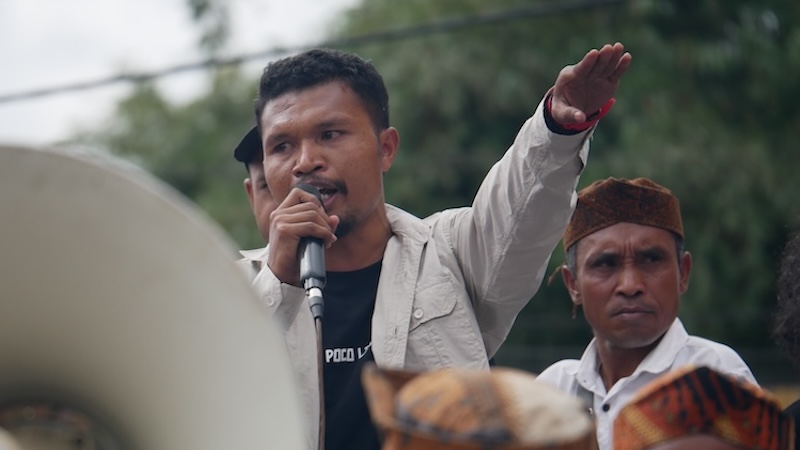
Servasius Masyudi Onggal is a member of the Poco Leok Youth Community and is involved in advocacy opposing a geothermal project in his village operated by Indonesia’s state electricity company and financed by a German bank.