



In recent months, Flores island in East Nusa Tenggara province has seen a surge in military facility construction, part of President Prabowo Subianto’s broader expansion of armed forces infrastructure.
The plan has sparked both support and opposition. Some, including the Indonesian Army itself, argue that the military’s presence will strengthen strategic positioning and boost Flores’ economy. Others worry about its impact on land, community living space, civil liberties, and the agrarian character of Flores.
One focal point of this controversy is Tonggurambang, Nagekeo Regency, where dozens of families face military claims over hundreds of hectares of farmland they have cultivated for decades. A base is being built there, while residents continue to question the army’s claims over their land.
Local Catholic Church elements have joined protests against the project, prompting the Nagekeo government to step in. Other areas targeted for bases include East Manggarai and Ende regencies.
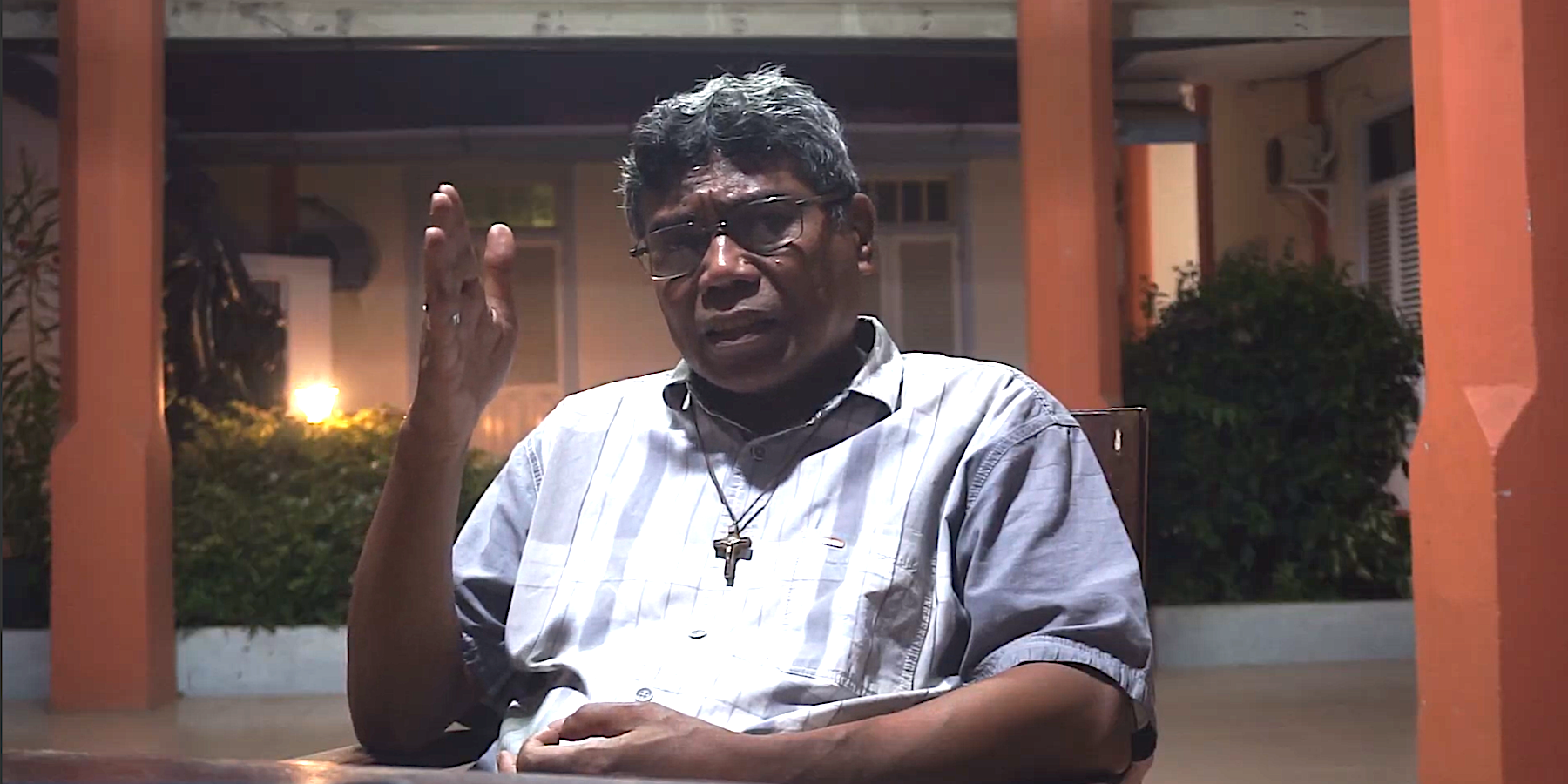
Amid this situation, Divine Word Archbishop Paulus Budi Kleden of Ende, known as a critical and outspoken Catholic leader, expressed his concern.
He questioned the logic of deploying so many troops in Flores, a region he described as peaceful.
“Do we really need such a large-scale military presence? I am convinced we do not,” he said.
Previously, Archbishop Budi, 60, former Superior General of the Society of the Divine Word, had vocally opposed geothermal exploitation projects. His stance was later echoed by other bishops in Flores, who signed a joint statement in March 2025.
Besides leading the Archdiocese of Ende, Archbishop Budi also serves as Vice President of the Indonesian Bishops’ Conference (KWI). On June 30, Pope Leo XIV appointed him as a member of the Dicastery for Evangelization, tasked with advising the Vatican on Catholic mission work worldwide.
He welcomed Floresa journalists Dominiko Djaga and Arivin Dangkar on June 30 at his residence in Ndona, Ende. Over the course of an hour, he shared his views on military expansion, the ethical stance of the Catholic Church, and his message to the government, military, and Flores society.
In recent years, Flores has become the target of military facility construction. How do you see this development in the context of the island’s future?
This is something very alarming. With current developments, we can already see and predict that militarization in Flores is becoming a reality. What worries me is the shrinking space for civil society.
What we need is a civil society that grows mature, lives in freedom, and can actively participate in democratic life.
The military is certainly needed, but in the right proportion as regulated by law. Therefore, the presence of the military in what I consider an over-proportional scale is alarming and must be taken seriously.
I am grateful and fully support those who care about this issue, who voice rejection of the planned military units. This concern must not be treated as normal.
In my view, this condition deviates from the ideals of a democracy that gives supremacy to civil society, enabling them to live responsibly and healthily in democracy.
What is the fundamental reason this deserves serious attention?
The basic question is: what reason does the state have to deploy the military in such large numbers? Not only personnel, but also organizational structures and massive facilities.
I do not see sufficient reason for such a military buildup. If there is a reason, it seems only to increase military presence itself, not to meet the real needs of society.
What people need is living space and land for livelihood. If that land is taken for military purposes, where will people work? Where will they find sustenance?
Some battalions are being built within the Archdiocese of Ende. How does the archdiocese respond?
We continue to monitor developments. For example, in Kurubhoko (Ngada Regency), priests there are following issues related to land acquisition plans. They hear of plans to take over about 100 hectares.
Again, the question is: do we really need such a large-scale military presence? I am convinced we do not. Why? Because it seems as if society is viewed as a threat that must be countered with massive military deployment.
But we are loyal citizens. We have no ambitions or goals that threaten the state. So why this military buildup? For what purpose? I see no justification.
What should the state prioritize for Flores instead?
Flores’ strategic value should be built by strengthening its economy, advancing culture, improving education, and developing human resources capable of facing modern challenges.
Strategic value will not increase simply through military presence. It will increase by building people, strengthening the economy, spiritual life, and knowledge.
The first priority must be democracy. Decisions affecting society must not be imposed unilaterally or made behind closed doors. They must be built through democratic participation.
Economically, land is the foundation of life for Flores people. If land is taken, how will they survive? Development should focus on education and economic empowerment, not land seizure.
Supporters argue military facilities will bring economic benefits. How do you respond?
Investment is needed to develop potential. But investment must remain under the control of Flores society and serve their interests.
I am not against investment. I support it, but it must empower locals, ensuring ownership and control remain with Flores people, especially villagers who depend on the land.
They know best what they need. No one should unilaterally declare their land a geothermal or military zone without involving them.
True welfare is measured by respect for dignity and rights. People must be subjects of development, not mere followers of others’ agendas.
In Tonggurambang, land disputes continue while construction proceeds. What principle should guide resolution?
The people must be heard. This is not empty land. It has history and owners. Decisions must respect their free choice.
If people are ignored and decisions imposed, discomfort and conflict will arise. Dialogue with truly free communities is essential — not those pressured, bribed, or threatened.
History must be remembered. Civil society, media, and education must keep collective memory alive, so people do not forget past repression.
We must also learn from other regions dominated by military presence, to foresee consequences for Flores.
What role should the Church play?
The Church exists because God became human and entered the world. Therefore, the Church must be present in people’s joys and anxieties.
The Church does not float above reality; it lives concretely in society. Speaking out on these issues is part of its mission.
If the Church remains silent, it betrays its essence. Of course, reactions will come, but what matters is speaking the truth for the sake of many.
What is your message to government, military, and Flores society?
Respect the people, their rights, traditions, and values. Flores needs living space — that is the most basic need.
All institutions — Church, government, military — must help society grow freely and democratically, not dominate their lives.
The military must remain in its proper role as a defense tool, not take over civilian space.
Do not assume people cannot decide their future. They can. Our task is to encourage and support them.
My dream for Flores is a democratic island, respectful across generations, genders, and religions. A society aware of its rights and responsibilities, upholding civil sovereignty, and caring for the environment.
Flores is small but rich in potential. That potential must be managed responsibly, sustainably, and for the good of present and future generations.