



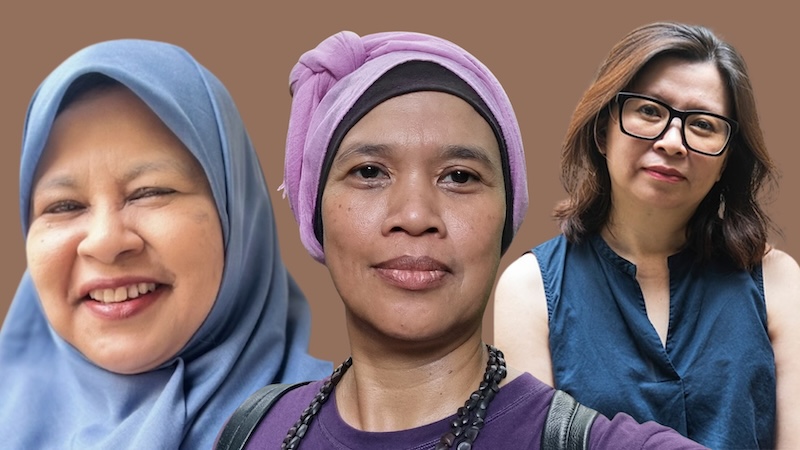
Floresa.co — Women journalists remain a minority in Indonesia, making up only about one-fifth of the profession.
This imbalance is seen as limiting the media’s ability to report on the climate crisis in ways that reflect the experiences of women and vulnerable groups.
Chairperson of the Alliance of Independent Journalists (AJI) Indonesia Nany Afrida said that as of 2025, women journalists accounted for around 21.5 percent of the total. The figure, cited from the Portrait of Indonesian Journalists 2025 report, shows little improvement compared to a decade ago.
“This reflects persistent structural inequality in the media industry. Women journalists are not only underrepresented but also face systemic barriers in their work,” Nany said during the “Marginalized Lenses” talk show at the 2026 AJI Jakarta Media Festival on April 11.
She added that women journalists face layered pressures, including gender-based violence, newsroom discrimination, double workloads, weak labor protection, and digital attacks.
AJI recorded 91 cases of violence against journalists in 2025, around 11 involving women journalists.
The shortage of women journalists has also affected recruitment, especially in environmental media.
Mongabay Indonesia Managing Editor Sapariah Saturi said her outlet still struggles to recruit women journalists, despite their crucial role in producing deeper and more inclusive climate reporting.
“Women are often more open to sharing their experiences with women journalists, which results in more comprehensive stories,” Sapariah said.
Evi Mariani, co-founder of Project Multatuli, emphasized that the presence of women journalists should not be seen as a quota, but as necessary to broaden media perspectives.
“When women journalists with gender awareness are present, they bring experiences and knowledge that have never been heard or seen in previous reporting,” Evi said.
She noted that issues such as postpartum mental health, care work, and the domestic impacts of climate change are often overlooked due to their absence in newsrooms.
The speakers agreed that increasing the number of women journalists and improving their working conditions are key to producing fairer and more inclusive climate crisis coverage.